I’ve been experimenting with Blue Iris and CodeProject AI in my lab to see what type of performance I would get utilizing Intel on-board CPU-GPU (Intel 630) and an Nvidia GTX 1650 4GB. The machine I’m using to test this is an HP Elitedesk 800 G3 Small Form Factor (SFF) with 32GB of RAM on an Intel i7-7700. The storage is a combination of NVME, SSD, and RAID-0 Western Digital purple.
From an “opinion based perspective”, I was seeing really good performance with just the Intel 630 onboard CPU-GPU. Once I added the Nvidia and moved three 4K-capable cameras to using the Nvidia, I noticed performance go from really good to great. Some of the 4K cameras view a large field of hay. With the Intel onboard GPU, I could see the grass moving but it was slightly delayed as I looked out of the window and watched Blue Iris simultaneously. Once I put those cameras on the Nvidia GPU, there was almost no delay and I could see the individual grass strands (?) blowing in the wind. Opinions sometimes carry more “weight than the law” so this is a winner in my book. Even with just the Intel it was doing really good.
There are quite a few threads on Reddit and IPCamTalk forums about how to determine which GPU is being used. I was able to see the GPU in use per camera using the Blue Iris Status window ( |_ with an arrow pointed to the top right) which is under the HA (Hardware Acceleration) column.

HA: Hardware acceleration. When a value is shown, the camera is currently using hardware decoding (I=Intel, I+=Intel+VPP, N=Nvidia, DX=DirectX, I2=Intel Beta).
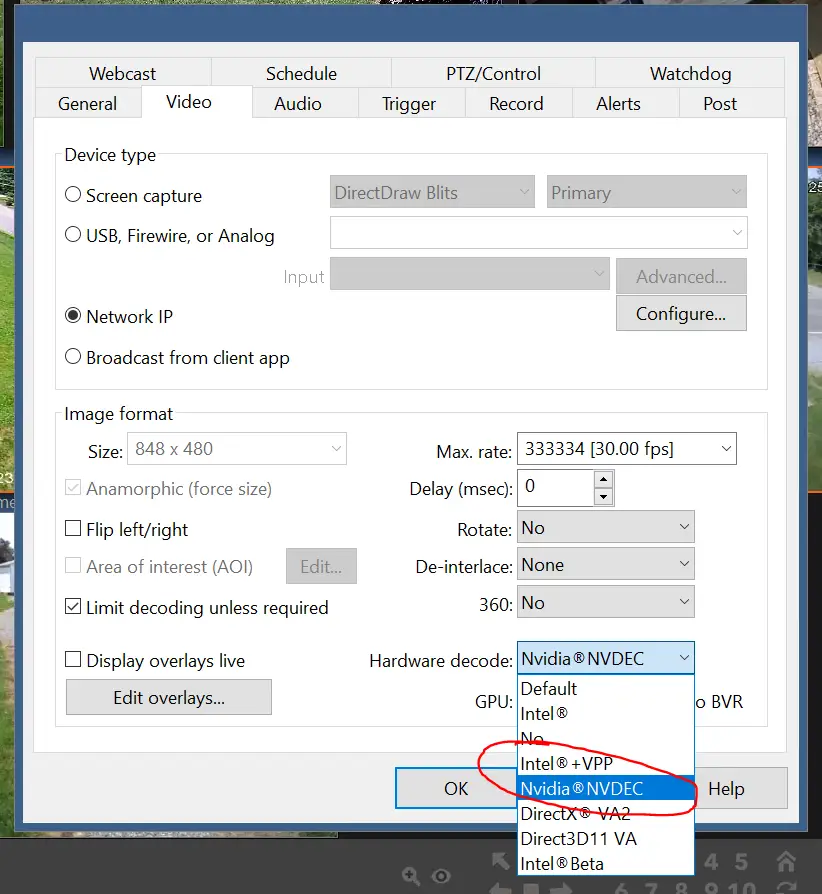
In order to specify which camera HA I was using, I edited my 4K cameras to use the Nvidia GPU.
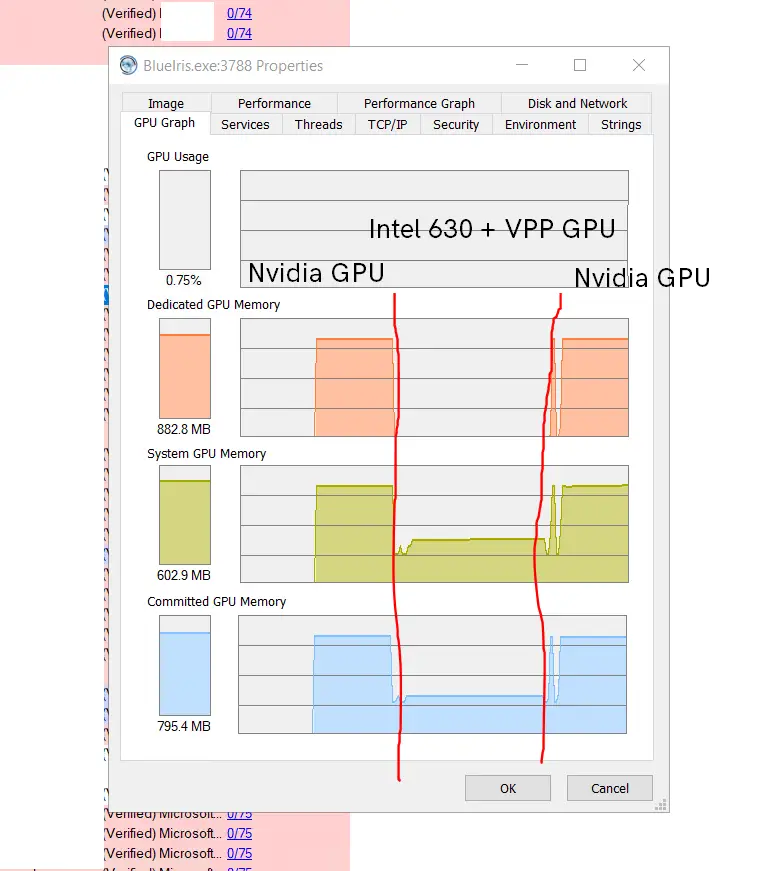
I switched between Intel+VPP and Nvidia and this is what ProcessExplorer showed as far as GPU utilization.
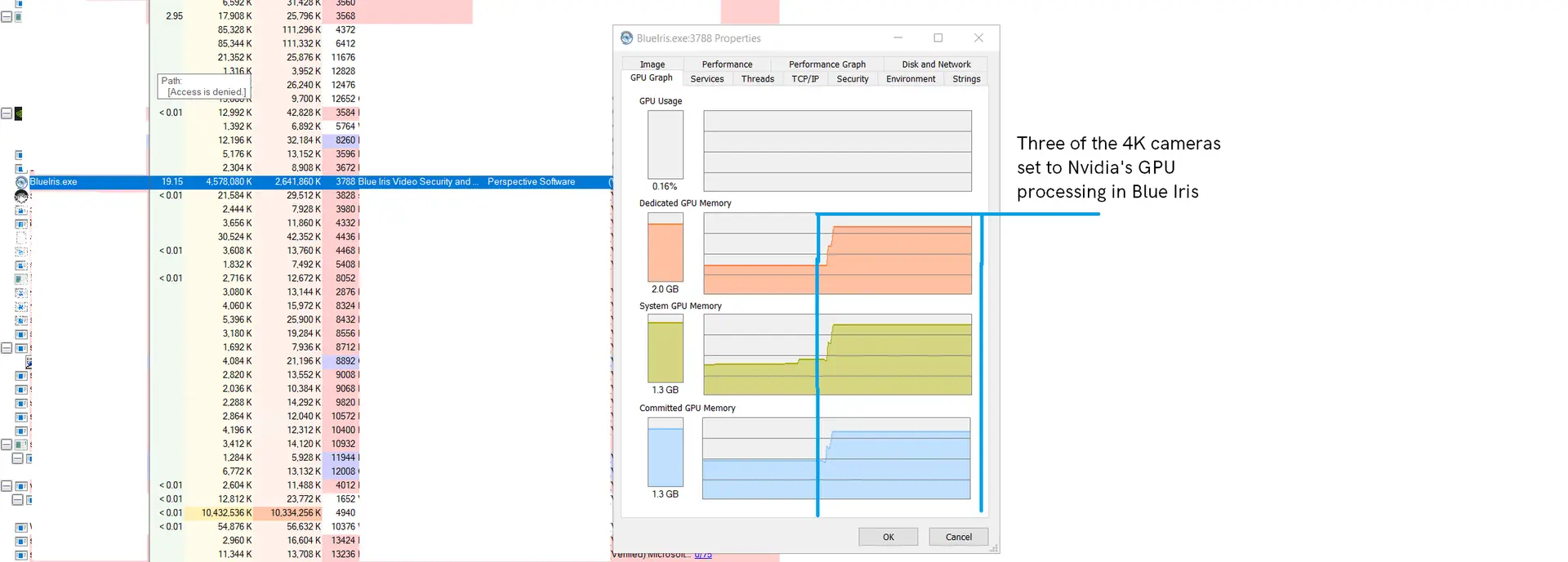
When I added a third camera, I viewed stats in real time. I noticed a difference between requested resolution using Intel+VPP versus actual resolution using Nvidia.


I’m also using CodeProject AI in a Docker container running on the Elitedesk 800 G3 and I noticed an improvement once the Nvidia GPU was added. I did have to set my Docker instance to use all GPUs but it was easy enough. Two big improvements when using the Nvidia GPU and the Docker setup: 1) the modules in CodeProject stopped crashing. Before using Nvidia, the modules kept crashing and restarting. 2) The AI processes much faster. Although I don’t have a baseline screenshot of CodeProject using Nvidia, I did notice it was using about 300-350 MB of GPU RAM before I started adding cameras to use Nvidia so the footprint is really small.
As always, many thanks to my friend (and author!) Blaize for letting me bounce around ideas.
I wish this article was more… “helpful”.
While you give details about the playback experience with Intel vs nVidia GPU, it’s it not convincing. The difference in resolution for Intel is minimal (3808 vs 3840) which could be attributed to some setting.
For GPU utilization it’s even worse! You are showing Memory utilization which, when you have 32G is irrelevant if you use 300 MB or 600 MB. You should have shown the actual GPU utilization because when it reaches 100% you start dropping frames, etc.
For the CodeProject AI Part, the crashes will happen if you use the non .NET YOLO without NVIDIA GPU.
You say the AI processes much faster. I was hoping for more details here!
Finally, no mention about power usage. That GTX 1650 is 75W which is more than 65W for i7-7700 CPU+GPU. Performance comparison is good, but efficiency also matters.
Thanks for commenting. I did state that that the data is “From an opinion based perspective…” and did my best to convey that opinion.
If there is something that you’d like to see and if you think that I can produce the data in my lab then let me know and I’d be happy to run some tests for ya.
Thanks for getting back to my comment.
I don’t mean to put you through some rigorous scientific testing to get accurate results, but I would like to know how the two GPU usage patterns compare (Task Manager > Performance > GPU 0, GPU 1) when idle, viewing full screen video on a remote web client, and AI detection.
Also, how noisy is the GTX 1650 vs just the iGPU? (this can be a good indicator of power consumption (if you don’t have a watt meter)
Some baseline stats before I make changes:
GPU 7.6 GB of 8.0 GB (the engines don’t tell me which GPU is assigned)
BlueIris.exe – CPU spikes to 39% with motion and idles around 4.50%. RAM is ~ 9.2 GB
CodeProjectAI.Server.exe – CPU <.0.01%, Python spikes to 56.94% and idles around 35.12%. RAM is ~4.7 GB
———– INTEL GPU only ———–
Switching all 11 cameras to Intel GPU only, the GPU dedicated memory drops and holds at 3.2 GB.
BlueIris.exe – CPU spikes to 35% and idles around 11%. RAM is 4.1 GB.
CodeProjectAI.Server.exe – CPU <.0.01%, Python spikes to 62.73% and idles around 35.12%. RAM is ~4.7 GB
———– NVIDIA GPU only ———–
Switching all 11 cameras to Nvdia NVDEC GPU only, the GPU dedicated memory rises and holds at 7.6 GB.
BlueIris.exe – CPU spikes to 28% and idles around 4.34%. RAM is 8.4 GB.
CodeProjectAI.Server.exe – CPU <.0.01%, Python spikes to 72.06% and idles around 36.40%. RAM is ~4.7 GB
———– Remote viewing ———–
No changes in Intel or NVIDIA GPUs, but BlueIris.exe spikes the CPU to 100% then idles between 75-95% (4 cores with HT, 8 processors) with remote viewing.
———– Disks ———–
I/O is minimal even during remote playback.
Disk layout is:
C: (OS), D: (Hot Storage), E: (Cold Storage)
BlueIris writes to Hot Storage then after 30 days or disk full moves contents to Cold Storage.
OS disk is NVME Samsung MZVPV256.
Hot Storage disk is Intel SSDSC2BA800G3E which is an Intel Enterprise SSD.
Cold Storage is Intel Raid 0 – two striped 4TB WD Purple disks.
———– Noise———–
Noise is minimal, although it’s a little hard to tell because the BlueIris server is in a server rack. I briefly killed the rack fans and you can hear the fans running. MSI Afterburner and CPU-ID HWMonitor are not outputting fan tachometer RPMs, but the fan speed is around 30% with NVIDIA GPU temperatures around 116.2F. I used MSI Afterburner to set the fans to 100% and GPU temperatures dropped to 110.5F.
GPU power went from 16.7 watts to 19.1 watts when I moved the fans to 100%. Setting the GPU fans to automatic control reduced speed to 37% and power dropped to 16.7 watts. Briefly dropping the fans to 0% reduced power to 16.6 watts and temperatures only slightly rose to 116.2F.
HWmonitor says the max GPU power usage was 19.79 watts and minimum was 16.60.